


Many product listings present a metal band as either a solid link bracelet or nothing, and that's the first mistake to drop. A classic style stainless steel Milanese mesh watch strap is woven from fine stainless steel wire, so it bends and drapes like fabric while keeping a dressy metal finish.
Shine alone tells you nothing about how the mesh is built. Judge a strap by its wire, weave density, taper, edge finish, clasp and fit.
Table of Contents
- What Is a Milanese Mesh Watch Strap?
- How Is the Mesh Woven and Which Details Matter?
- Why Does a Sliding Magnetic Clasp Fit Better Than a Holed Buckle?
- Does Stainless Steel Make a Milanese Strap Hypoallergenic?
- Is a Milanese Mesh Strap Comfortable All Day?
- Which Watches Take a Milanese Mesh Strap?
- Is a Milanese Mesh Strap Right for Your Routine?
What Is a Milanese Mesh Watch Strap?
A classic style stainless steel Milanese mesh watch strap is a band woven from fine stainless steel wire into a flexible, fabric-like mesh, and it's the dressiest metal option that still bends to the wrist. A solid link bracelet behaves like plate armour: rigid segments that hinge at set points, with gaps wherever those segments can't match your wrist's curve. Milanese mesh has no hinge points at all, so the whole surface follows the wrist instead of bridging across it.
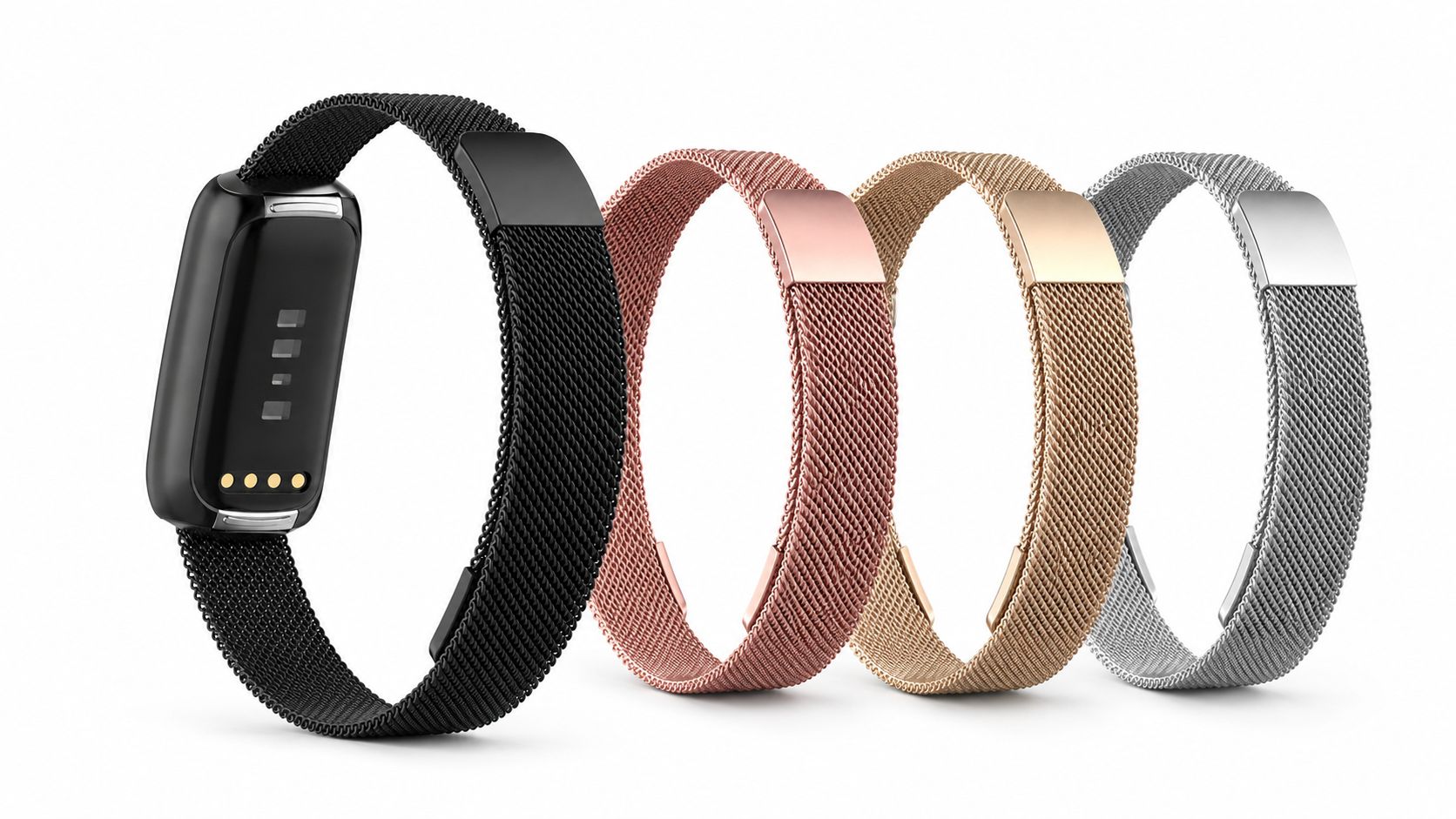
Say you're dressing up a plain smartwatch for dinner. A silicone band looks sporty, a link bracelet can feel stiff under a cuff, and a Milanese mesh strap sits flat, catches light across the weave and still moves when you flex your wrist. That combination explains why owners keep wearing one.
Where Does the Milanese Name Come From?
The name points to Milan, Italy, where 19th-century goldsmiths handcrafted mesh bracelets and jewellery long before the construction reached a wristwatch, and the technique shares its logic with chainmail: small interlinked elements forming a flexible metal surface. Pforzheim makers such as Vollmer and Staib turned that handwork into industrial production, popularising the style in Germany in the 1920s, and it took off on dress and dive watches in the 1960s, as the Monochrome history of metal watch bracelets traces.
Four things decide whether you'll keep wearing a Milanese mesh strap: the weave, the clasp, daily wear and fit on your watch. The weave sets how smoothly the band drapes and whether its edges stay smooth against skin and arm hair. The clasp sets how precisely you can size it. Daily wear covers sweat, snags and contact with desk edges. Fit is whether the band sits flat against your case and lugs.
Every Milanese in the Nothing but Bands range is a Magnetic Milanese with a sliding magnetic clasp. We sell replacement bands only, and we don't offer a traditional fold-over or hook Milanese.
How Is the Mesh Woven and Which Details Matter?
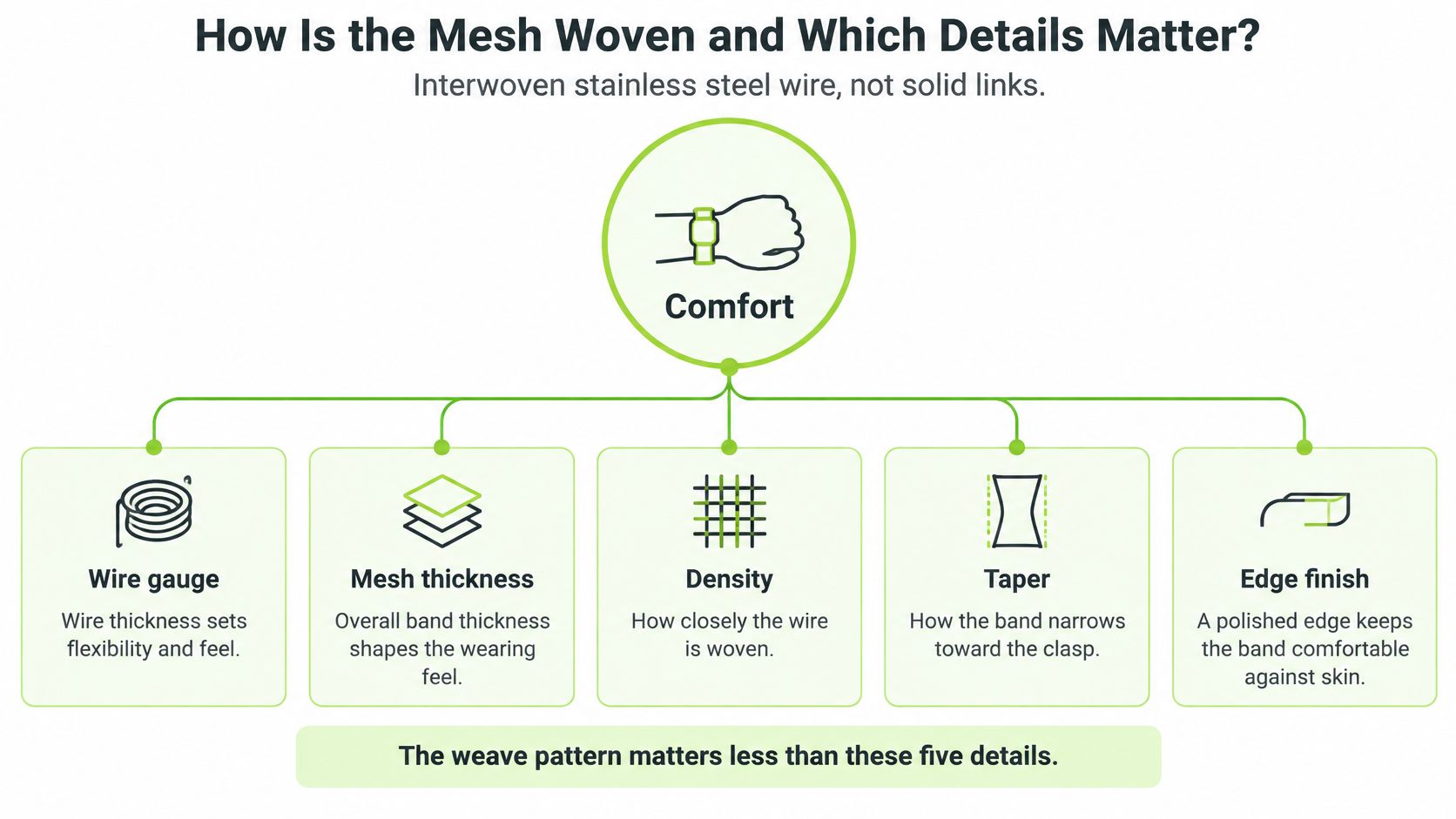
A Milanese mesh strap is woven from stainless steel wire, not machined from solid links, so wire gauge, mesh thickness, density, taper and edge finish shape comfort far more than the surface pattern does. Photos sell the pattern. The five construction details below are what you feel after eight hours on the wrist.
Weave Details and What Each One Changes
| Feature | What it changes | What to look for |
|---|---|---|
| Wire diameter | Stiffness and shape retention | Finer wire drapes sooner; heavier wire holds its shape |
| Mesh thickness | Profile on the wrist and visual weight | Thinner mesh reads dressier; thicker mesh looks more substantial |
| Weave density | Smoothness of drape and moisture held in the mesh | Even, tight weave without visible gaps; very tight weave holds more moisture |
| Taper | How the band narrows from case to clasp | Gradual taper that hugs the wrist, no abrupt step |
| Edge finish | Whether cut ends snag arm hair or skin | Smooth, finished edges with no burrs |
Does Wire Diameter Change How Stiff a Milanese Mesh Strap Feels?
Wire diameter changes how stiff a Milanese mesh strap feels because thicker wire resists bending and holds its shape, while finer wire drapes more easily. A strap that feels boardy across the top of your wrist usually has heavier wire or a very tight weave. A strap that folds softly in your hand will usually settle faster on a smaller or bonier wrist.
Density pulls in two directions. A tighter weave looks more solid, reads dressier and moves as one smooth surface, but it also holds more sweat and moisture inside the mesh. A looser weave lets more air through, yet visible gaps can look cheap and give arm hair more places to catch.
Why Does Taper Matter on a Milanese Mesh Strap?
Taper matters on a Milanese mesh strap because a gradual narrowing from case to clasp hugs the wrist, while an abrupt step can dig in at the side. Run your eye along both edges before you wear a new band. The width should reduce evenly, with no kink where the mesh meets the connector or clasp.
Edge finish is the detail buyers overlook most. In product photos the weave fills the frame, while the sheared line where the mesh is cut at the clasp and connector ends barely shows. That cut line is exactly what sits against skin and arm hair all day. Patricia Hernandez, reviewing the Solin — Magnetic Milanese — Quick Release 20mm, put it plainly: "Quality’s top-notch; the metal feels solid and durable while still being light on the wrist. The craftsmanship is impressive, with no rough edges or anything that’d snag your skin."
Run a fingertip slowly along both edges and across the underside before the first full day of wear. Any sharp point you can feel with a dry finger will feel worse after hours against skin.
I would use a three-point check on any Milanese mesh strap. Feel the edge and underside for burrs, confirm the taper is even on both sides, and flex the mesh to check that no section feels sharp or crunchy. None of the three needs tools, and together they tell you more about the construction than any photo.
Why Does a Sliding Magnetic Clasp Fit Better Than a Holed Buckle?
A sliding magnetic clasp gives the Magnetic Milanese bands in the Nothing but Bands range a stepless fit because the clasp slides along the mesh to any length and magnets hold it there, while a holed buckle stops only at its preset holes. That difference sounds small in a product photo. On a wrist that changes size through the day, it is the reason to choose mesh.
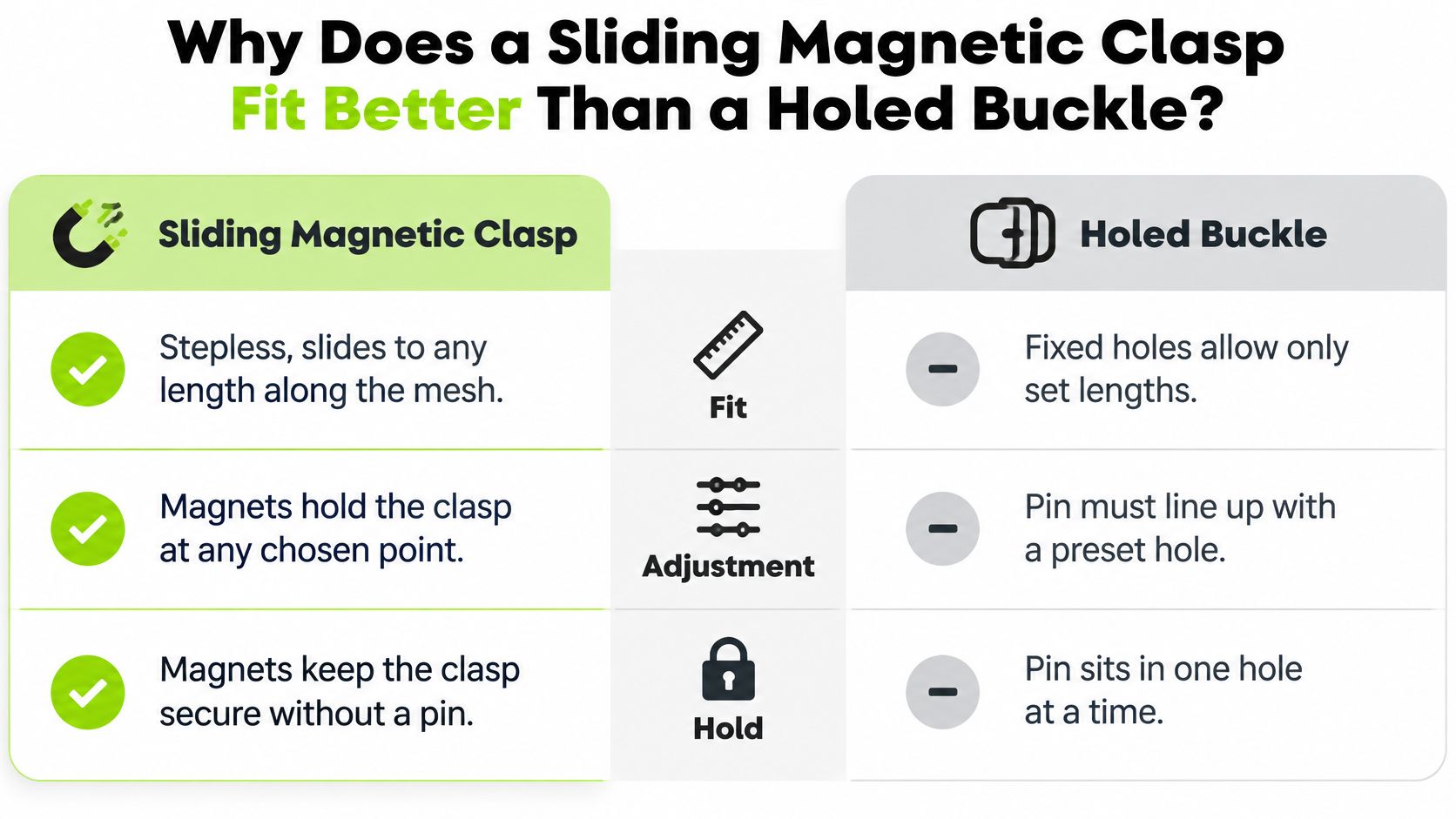
The useful comparison for this range is a sliding magnetic clasp against the holed buckle found on many leather, silicone and fabric bands.
What Happens When Your Wrist Swells in Heat?
When your wrist swells in heat, a sliding magnetic clasp lets you ease a Magnetic Milanese strap out by a few millimetres instead of jumping to the next buckle hole. A watch can fit well at breakfast, then feel tight on a warm train at noon. Slide the clasp slightly, wear the strap comfortably all afternoon, then return it to the shorter length in cooler evening air.
A holed buckle cannot make that small move. One hole pinches, the next lets the watch spin, and you spend the day pushing the case back into place. If the back of the watch keeps wandering, I recommend nudging the fit tighter for exercise and loosening it again once you cool down.
The short clip below shows the sliding action in use.
Check three things when a Magnetic Milanese strap arrives. The magnets should hold the clasp firmly closed, the clasp should slide without catching on the mesh, and it should stay aligned after several openings and closings. A clasp that twists or scrapes will annoy you daily and can mark the finish where it rubs.
Practical rule: Choose a sliding magnetic clasp if your wrist size changes with temperature, exercise or season. Expect a holed buckle to suit only a wrist that stays much the same size all day.
Does Stainless Steel Make a Milanese Strap Hypoallergenic?
No. A stainless label covers the mesh alloy, while the metal that reaches your skin includes the clasp, plating, pins and adapters. On a woven band the contact area is spread across many fine wires, so edge finish and worn coating matter as much as the name on the listing.
Patch testing of 100 nickel-sensitive subjects found that three non-plated stainless-steel alloys produced no reactions, while nickel-containing interlayers and some plated alloys did, and wristwatches were among the objects most frequently associated with dermatitis, in the British Journal of Dermatology study on nickel release from stainless steel. Read that as a buying rule: bare, well-finished steel is one exposure, plated colour and hidden layers are another.
The clasp deserves the same suspicion as the mesh because it sits under the wrist and rubs through sweat, soap and sunscreen. Irritation can also come from pressure, trapped moisture or residue, so persistent redness needs a better test than a guess at the steel grade.
What Should You Ask Before Buying a Milanese Mesh Strap for Sensitive Skin?
Before buying a Milanese mesh strap for sensitive skin, ask whether the mesh, clasp, pins and adapters are plated and whether the seller holds nickel-release documentation. Use this checklist:
- Mesh plating: Is the coloured finish plated, and what sits under it?
- Clasp construction: Is the clasp plated or bare metal against skin?
- Pins and adapters: Are the small hardware parts the same material as the mesh?
- Release evidence: Does the seller distinguish nickel-containing from nickel-releasing with test documentation?
For any Milanese, ours included, treat a "low nickel" or "hypoallergenic" label as a claim until the seller can show nickel-release evidence for each part that touches skin. If metal has caused trouble before, silicone, nylon or leather keeps metal off the skin entirely.
Ask for documentation first if you have a known sensitivity. If persistent redness, itching or blistering develops, stop wearing the Milanese mesh strap and ask a clinician about patch testing.
Is a Milanese Mesh Strap Comfortable All Day?
Comfort depends less on the word Milanese than on wire density, taper and edge finishing. A tight, smooth weave with a clean edge can disappear under a cuff; a coarse weave or a sharp cut edge will announce itself by lunchtime. A Magnetic Milanese such as the Solin — Magnetic Milanese — Quick Release 20mm stays light on the wrist, although mesh can feel warmer than silicone or nylon when you sit still in heat.
Long desk days expose the small faults first. By mid-morning the clasp has usually settled into one position, by afternoon the edge either glides over sleeve fabric or catches it, and one rough point can turn an otherwise even band into a hair puller. I treat repeated pulling at one exact spot as a finishing problem until proven otherwise.
Daily Wear Points and What to Do About Each
| Wear point | What happens | Early sign | What to do |
|---|---|---|---|
| Warm weave | Mesh can hold more warmth than silicone or nylon | Band feels warm during still work or travel | Loosen the clasp one position or switch to nylon for hot workouts |
| Arm hair | Fine hairs catch at a rough edge or cut point | The same spot snags again | Inspect the edge for a burr; a snagging edge is a defect |
| Clasp plate on the wrist bone | A thick or rough plate presses into the bone during long wear | Pressure mark or soreness | Reposition the clasp; if pressure stays, try a different band |
| Plated colour at high-contact edges | Plating rubs through where the mesh meets the clasp | Lighter base metal showing at edges | Keep the band dry and treat worn plating as finish wear, not a fit problem |
The edge and the clasp decide more complaints than the mesh pattern does. A tapered band should narrow toward the clasp without leaving a stepped shoulder, and the clasp plate should spread load rather than concentrate it on the wrist bone during typing or driving.
Comfort check: If hair pulls repeatedly at one exact spot, inspect that spot. Even mesh should glide, so a single snagging point points to a burr rather than normal mesh behaviour.
Do Plated Colours Wear on a Milanese Mesh Strap?
Plated colours on a Milanese mesh strap wear first at high-contact edges, where the mesh meets the clasp and plating can rub through to lighter base metal over time. Lighter finishes disguise that change better because the exposed metal is closer in tone; dark and warm colours make the same wear easier to see.
Choose the finish for the watch it sits on and the clothing it will meet, then keep the clasp area dry to slow edge wear. Cuffs, desk edges and bag straps all rub the same few points, so expect gradual change rather than sudden failure. Rinse the mesh through with fresh water after sweat, salt or sunscreen, dry it with a soft cloth, especially the clasp and underside, and avoid metal brushes or abrasive polish: residue removed before it dries is what keeps the finish looking clean. The full routine is in our guide on how to clean a Milanese watch strap.
Which Watches Take a Milanese Mesh Strap?
A Milanese mesh strap fits a watch only when its fitting matches the watch exactly: the right lug width on a standard spring-bar watch, the right case family on an Apple Watch, or the right connector on a Fitbit, Galaxy Watch or Garmin. The Solin — Magnetic Milanese — Quick Release 20mm, for example, suits watches with 20 mm lugs and no other width. Appearance can't settle compatibility. A band that sits right against the case can still have the wrong connector, width or clearance.
How Do You Measure Lug Width for a Milanese Mesh Strap?
You measure lug width as the distance between the inner edges of the two lugs. Case diameter and the buckle-end width are the wrong references; on a tapered strap, a size written as 20/16 mm gives the case-end width followed by the narrower buckle-end width. A watch with 20 mm between its lugs takes a 20 mm band. A watch with 22 mm lugs takes a 22 mm band.
Case size alone is unreliable. Two smartwatches with near-identical case diameters can use different band widths, and even models in the same family can change fitting between generations. Always identify your exact generation, verify the lug width or case family, and confirm the watch accepts the connector type on the band.
Milanese Fit by Watch Family in the Nothing but Bands Range
| Watch family | Connection type | Milanese in our range | What to verify |
|---|---|---|---|
| Apple Watch 38/40/41/42 mm case family | Apple case family | Vayra and Lunor Magnetic Milanese | Confirm your case size on the product page |
| Apple Watch 44/45/46/49 mm Ultra case family | Apple case family | Vayra and Lunor Magnetic Milanese | Confirm the Ultra case size before ordering |
| Samsung Galaxy Watch 8 and 9 | Model-specific fitting listed on the product page | Oryn Magnetic Milanese | Match the listed fitting to your exact model |
| Garmin QuickFit 20 / 22 / 26 | Garmin QuickFit latch | Veylan Magnetic Milanese | Match the QuickFit width to your watch; QuickFit is not ordinary quick release |
| Fitbit Charge 3/4, Charge 5/6, Versa and Sense, Luxe | Model-specific fitting listed on each product page | Lurea, Orivo, Nova and Solin Magnetic Milanese | Check the listed model on each product page |
| Universal quick-release 20 mm | Quick-release 20 mm | Solin Magnetic Milanese Quick Release 20mm | Confirm the watch has 20 mm lugs |
| Universal quick-release 22 mm | Quick-release 22 mm | Solin Magnetic Milanese Quick Release 22mm | Confirm the watch has 22 mm lugs |
Apple Watch bands in our range are listed by case family: you select your case size on the product page, with Vayra and Lunor sold as Magnetic Milanese options for Apple Watch. Galaxy Watch, Garmin and Fitbit owners should match the exact model and connector shown on each product page, because the fitting changes between generations. The Solin also works as a universal quick-release band in 20 mm and 22 mm for watches built for standard spring bars.
We list the fitting on each product page, and that listing is the authority. A strap that isn't listed for your watch isn't verified for it.
Adapters can change fit and appearance, but they don't remove width or clearance limits. If a Milanese mesh strap doesn't match your watch, don't force it onto the lugs. Forcing a connector can bend pins, scratch the case and leave the watch insecure on your wrist.
Is a Milanese Mesh Strap Right for Your Routine?
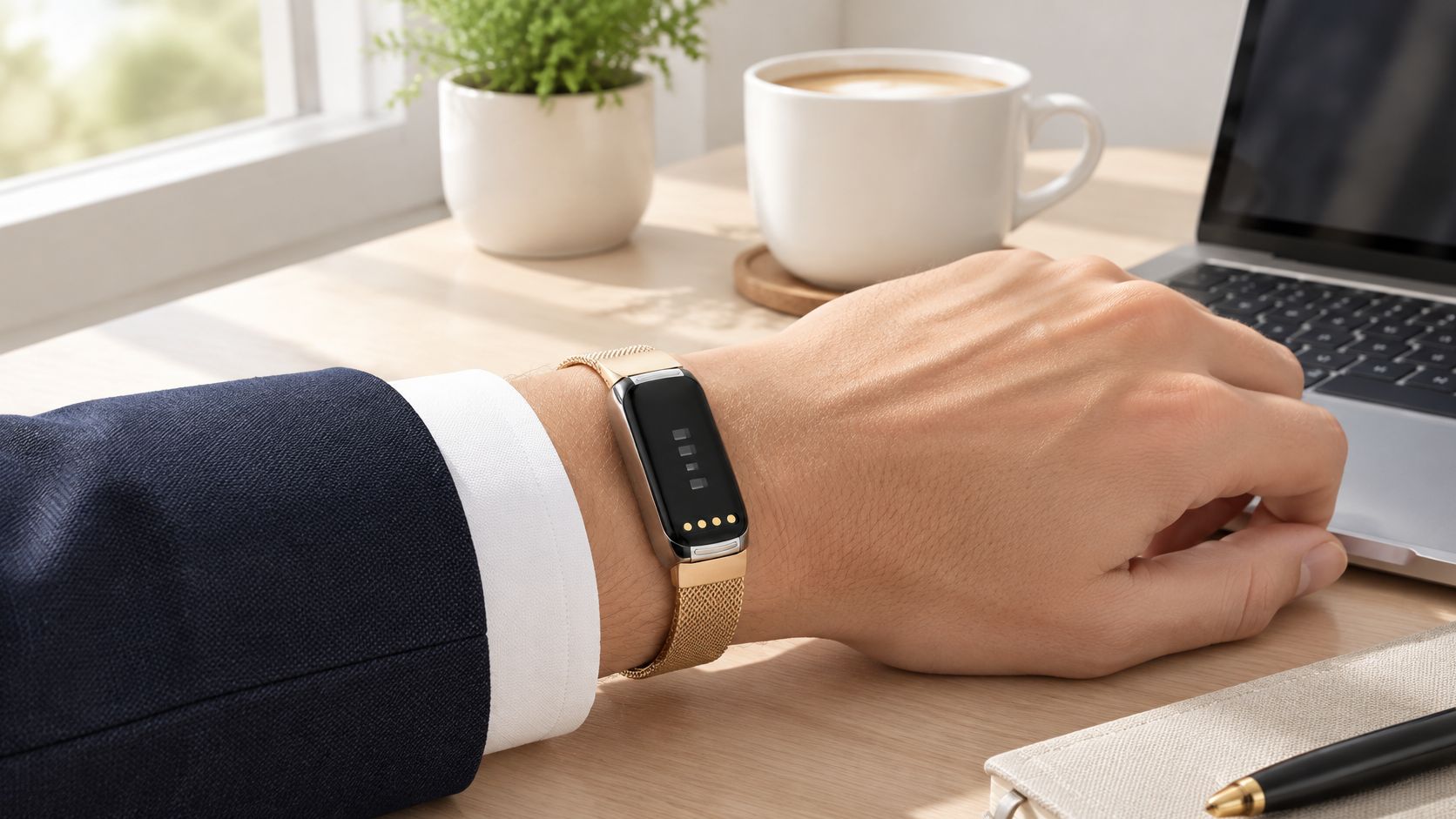
A Milanese mesh strap earns its keep in clean, low-impact routines where the flexible weave can sit flat under a cuff. Grease, grit, repeated knocks and sustained sweat change the equation because they collect in the mesh or stress the clasp. I would choose it for the day you have, not for the outfit alone.
Milanese Mesh Suitability by Routine
| Routine | Suits a Milanese? | Reason |
|---|---|---|
| Office and meetings | Yes | Dressy finish and a flexible mesh that drapes under cuffs |
| Evenings and weekends | Yes | Comfortable all day and easy to change for different outfits |
| Travel and commuting | Yes, with drying after damp weather | Light mesh that tolerates normal wear |
| Running or gym sessions | Not ideal | Sweat and salt sit in the mesh and around the clasp |
| Manual work and trades | No | Grease, grit and tools get into the weave and the clasp |
| Contact sport | No | Impacts can bend the mesh and stress the clasp |
Some routines sit between these rows. Office work followed by a damp commute still suits mesh, provided the strap is dried afterward. Office work followed by exercise calls for a band change rather than asking one strap to cover both settings. On dirty days, leave the mesh off entirely because cleaning cannot reverse a bent wire or a clasp damaged by impact.
Switching straps lets one watch move between settings. Nothing but Bands sells bands in leather, nylon, silicone and Milanese materials, so mesh can remain the polished option while another material handles workouts or rougher tasks.
Browse the full range of Milanese watch bands, use the Apple Watch bands collection if you own an Apple Watch, or start with quick-release watch bands for other brands. The Solin Magnetic Milanese, quick release is one Magnetic Milanese option; Apple Watch owners can choose between the Vayra and Lunor Magnetic Milanese bands.
Nothing but Bands sells replacement Milanese mesh straps across Apple Watch, Galaxy Watch, Garmin, Fitbit and universal quick-release fittings. Use the fitting and finish choices shown on each product page to find the Magnetic Milanese that fits your watch.
Ähnliche Beiträge

- October 27, 2026
Explore Apple Watch strap types by connector, closure, and material, with compatibility notes and practical advice for workouts, work, everyday...

- October 26, 2026
Apple Watch band install made simple. Step-by-step instructions for sliding in a new band, closing every common clasp, verifying the...
