


Forget the common advice to pick an Apple Watch strap by material first. Apple Watch strap types aren't a single list of materials, because every Apple Watch strap combines three separate choices, a case-family connector, a closure, and a material. Two straps can both be silicone yet fasten differently, and two straps can look almost identical yet fit different cases, so naming the material alone tells you the least useful third of the story.
Table of Contents
- What Are the Main Apple Watch Strap Types?
- Which Apple Watch Case Family Does a Strap Fit?
- How Do Apple Watch Strap Closures Work?
- How Do Flexible Apple Watch Materials Feel?
- Which Material Works Best for Workouts and Daily Wear?
- How Do Milanese, Leather, and Link Straps Differ?
- Which Apple Watch Strap Type Should You Choose?
What Are the Main Apple Watch Strap Types?
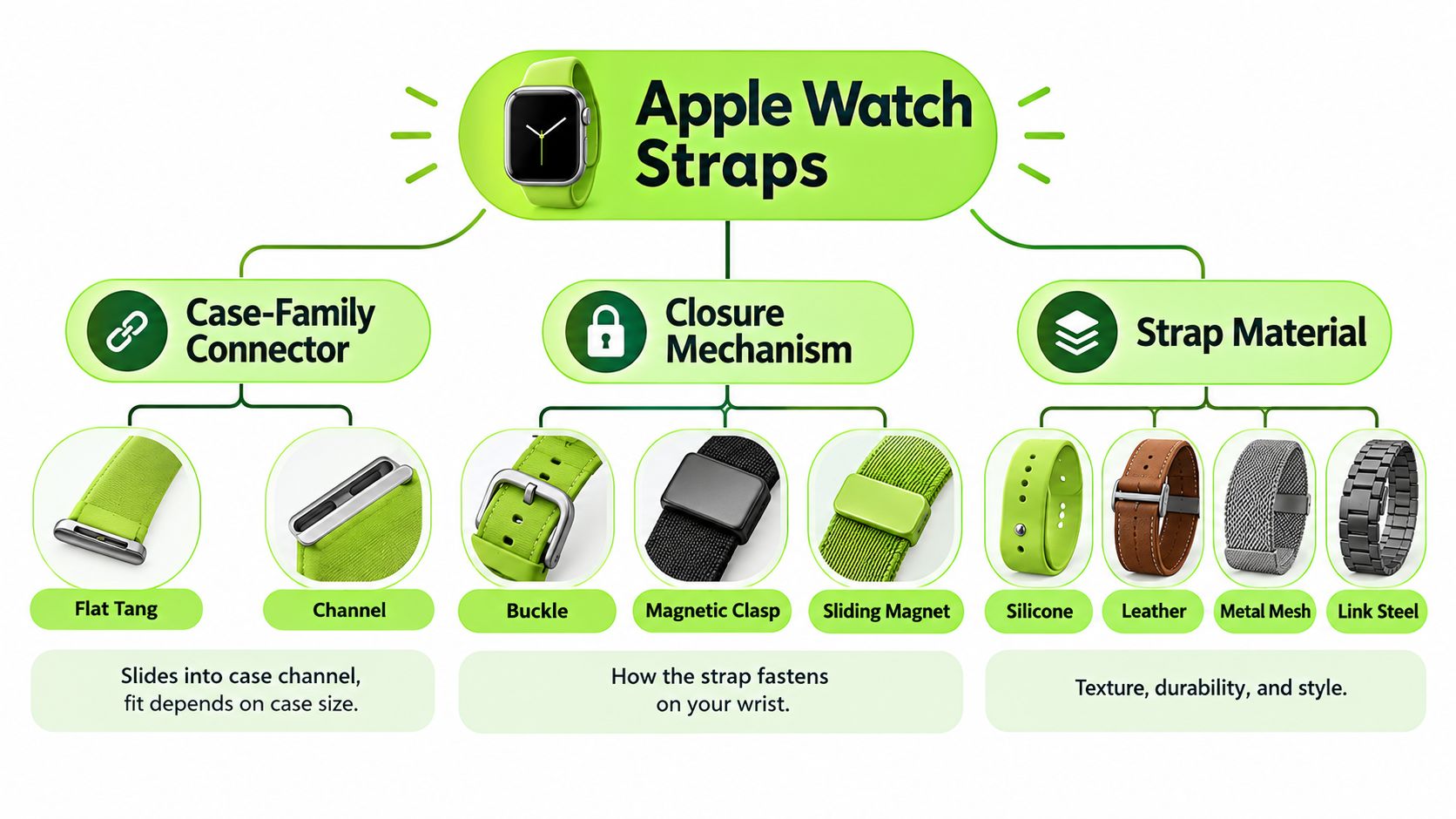
The main Apple Watch strap types are best understood as three layers, the connector that fits an Apple Watch case family, the closure that fastens the strap on your wrist, and the material that determines feel and care. A strap isn't "a nylon one" or "a Milanese one." Those words describe different layers. Silicone names a material, Milanese names a woven stainless mesh construction, and a Solo Loop style name describes a stretch-on closure with no fastener at all. Once you separate the layers, product names stop colliding.
Think of a shoe. You'd name the size first, then say whether it laces, slips on, or buckles, then say whether it's leather or canvas. An Apple Watch strap works the same way. Size here means case family, not wrist length. Fastening means pin-and-tuck, hook-and-loop, stretch-on, magnetic, or buckle. Material means what's against your skin all day.
What Materials Will You Actually Meet?
The core Apple Watch material families are silicone, woven nylon, magnetic Milanese stainless mesh, genuine leather, and resin composite links. In Apple's own range, Sport Band models use rubber or fluoroelastomer, Sport Loop models use woven nylon, polyester, and spandex, Solo Loop uses silicone, and Milanese Loop and Link Bracelet use stainless steel, according to Apple's guidance on Apple Watch band materials and water suitability. That spread is why material can't be treated as interchangeable.
You'll also encounter braided, steel link, titanium, and ceramic Apple Watch straps as types in the wider market. Those are classification examples here, not part of the range described later. Nothing but Bands doesn't sell a braided or stretch solo loop, a steel link bracelet, a titanium strap, or a ceramic strap for Apple Watch, and it sells replacement straps only, never watches. Naming that boundary now keeps the taxonomy honest.
Practical rule: If you can't say a strap's case family, closure, and material in one sentence, you don't yet know what you're looking at.
That one sentence becomes your shopping map for every Apple Watch listing you open.
Which Apple Watch Case Family Does a Strap Fit?
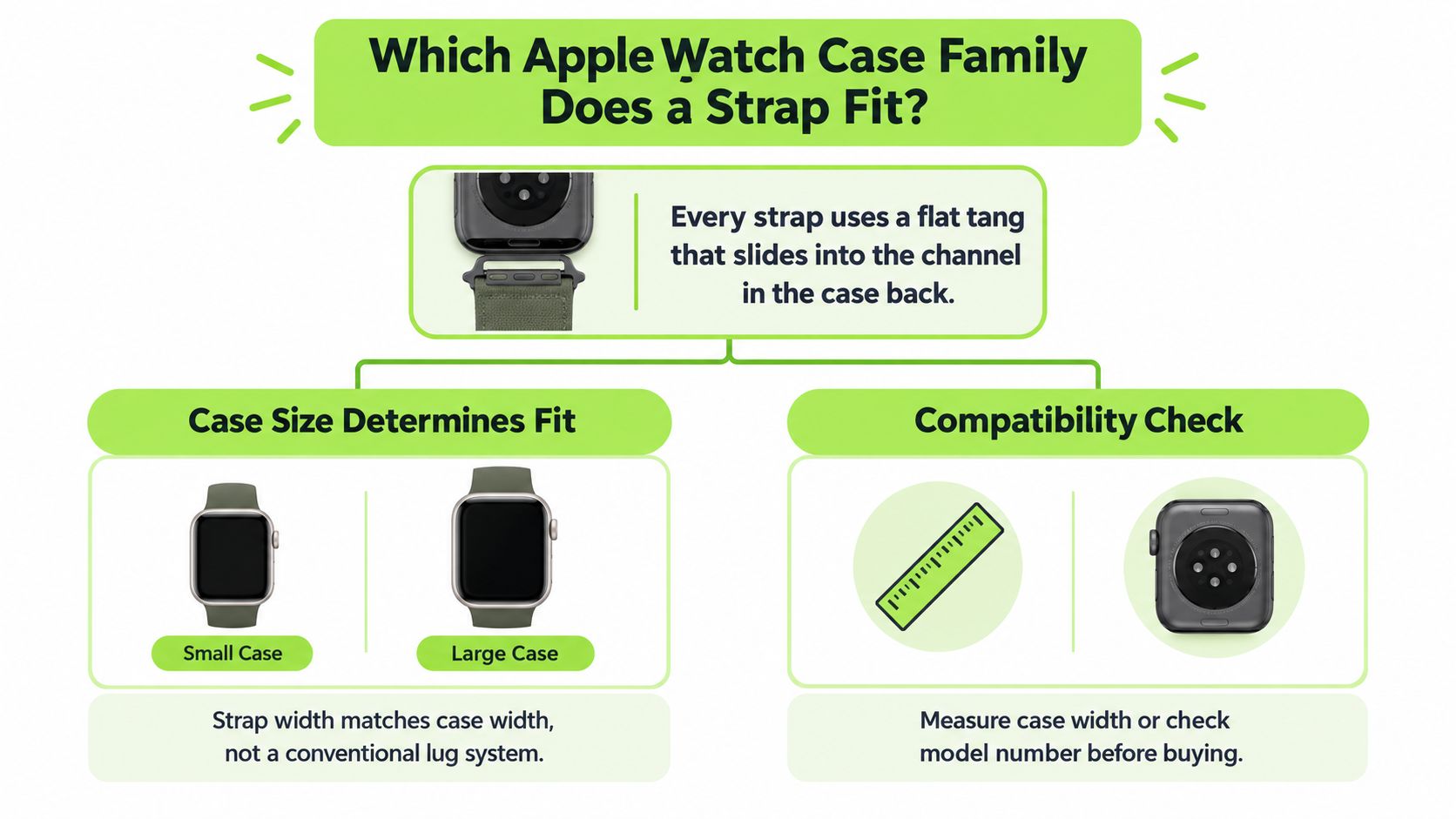
An Apple Watch strap fits the Apple Watch case family it was sized for, because every Apple Watch strap uses a flat tang that slides into the channel in the case back. There's no spring bar and no conventional lug width to measure. The tang is the same idea on every Apple strap, like a drawer sliding into its runner, but the width of that drawer changes with case size. That's why Apple straps are sized by case family, never by the 20 mm or 22 mm shortcuts used for many other watches.
Apple groups 38 mm, 40 mm, and 41 mm Apple Watch cases as one compatible family, and the 42 mm case of Series 10 and Series 11 joins that small family. The original 42 mm case of Series 1 to 3 belongs to the large family, together with 44 mm, 45 mm, and 46 mm cases. The same number, 42 mm, therefore sits in a different family depending on the generation, while the larger family covers the bigger standard cases as a group.
The 49 mm Ultra family sits at the top of that larger group. Bands designed for 44 mm, 45 mm, or 46 mm cases also fit the 49 mm case, and Ultra bands work back down to 44 mm, 45 mm, and 46 mm cases. An Ultra strap does not fit every Apple Watch, though. It won't fit a 38 mm, 40 mm, or 41 mm case, because those smaller cases belong to a separate compatibility family with a narrower channel.
How Do You Check Your Apple Watch Case Size?
You check your Apple Watch case size on the engraving on the case back or in the Watch app before you order an Apple Watch strap. Don't guess from the series name, because a single series came in two case sizes, so "Series 9" alone doesn't tell you the family, and a 42 mm Series 10 or 11 uses the small family while a 42 mm Series 3 uses the large one. Read the number, match it to its group, then shop inside that group only.
- Small case family: 38 mm, 40 mm, and 41 mm Apple Watch cases, plus the 42 mm case of Series 10 and Series 11, share straps.
- Large case family: 44 mm, 45 mm, and 46 mm Apple Watch cases, plus the original 42 mm case of Series 1 to 3, share straps.
- Ultra case family: 49 mm Apple Watch Ultra cases sit in the large family and accept bands sized for 44 mm, 45 mm, or 46 mm cases.
Once your family is confirmed, browsing Apple Watch straps by that family keeps every result physically able to connect. Fitment discipline, sorting by actual watch model and fitting system rather than a generic width, is what prevents the commonest wrong order.
Generation is a marketing label. Case size is the measurement that decides whether an Apple Watch strap connects at all.
How Do Apple Watch Strap Closures Work?
Apple Watch strap closures work in five main ways, pin-and-tuck, hook-and-loop, stretch-on, magnetic sliding clasp, and tang buckle with keepers. The closure is the layer you'll notice most often, because you operate it every time you put the watch on, loosen it after a run, or tighten it before sleep tracking. Material changes feel, but closure changes the daily routine.
You can identify each Apple Watch closure from a product photo if you know the clues. A pin-and-tuck shows a small metal pin on one piece and a row of holes on the other, with the loose tail tucking underneath. A hook-and-loop strap shows a fabric tab and a loop it threads through, like a trainer strap. A stretch-on strap has no visible fastener at all, just one continuous elastic band. A magnetic Milanese shows mesh overlapping itself, and a tang buckle shows a frame, a prong, and holes, like a belt.
| Closure | How to identify it | How it adjusts | Relevant examples |
|---|---|---|---|
| Pin-and-tuck | Metal pin, holes, tail tucks under | Fixed hole positions | Halo, Arc, Tide silicone |
| Hook-and-loop | Fabric tab threading through a loop | Continuous, anywhere along the tab | Muse Sport Loop |
| Stretch-on | No fastener, one elastic loop | Stretches over the hand, sized fit | Arden and Ridge Nylon Loops |
| Magnetic sliding clasp | Mesh or band overlapping itself | Continuous, slides to any point | Lunor, Vayra, Rovan, Sera |
| Tang buckle with keepers | Buckle frame, prong, holes, keeper loops | Fixed hole positions | Avelin, Harper, Leora, Perrin, Noren leather |
Why Does the Apple Watch Closure Change the Fit?
The Apple Watch closure changes the fit because continuous closures adjust anywhere, while holed closures force you to choose between set positions. If your wrist sits between two holes, a pin-and-tuck or tang buckle makes you pick slightly loose or slightly snug. A hook-and-loop tab or a magnetic Milanese clasp stops exactly where you leave it, which is why people who re-tension mid-workout often prefer them.
Stretch-on is the outlier. Apple introduced no-fastener Solo Loop bands that stretch over the hand, so the size has to be right at purchase because there's nothing to adjust later. The Arden and Ridge Nylon Loops use a stretch weave in that spirit, while the Muse Sport Loop keeps hook-and-loop adjustability. For how these Apple closures relate to clasps on other watches, see the overview of watch band clasp types and how each one fastens.
How Do Flexible Apple Watch Materials Feel?
Flexible Apple Watch materials feel different mainly in weight, breathability, and surface texture, with silicone feeling smooth and sealed and woven nylon feeling light and textile. Neither is a better version of the other. They're more like a rain jacket versus a cotton shirt, one sheds water and wipes clean, the other lets air through and feels softer against skin.
What Is a Silicone Apple Watch Strap Like to Live With?
A silicone Apple Watch strap feels smooth, slightly grippy, and wipe-clean, and a silicone Apple Watch strap reads sporty rather than dressy. Silicone has a soft, rubbery surface that doesn't absorb sweat, so a rinse or a wipe resets it. It holds the watch steady because the material grips skin lightly, which suits training, though that same seal can feel warm in heat if you wear it tight all day.
Adjustment depends on the closure paired with the silicone. The Halo, Arc, and Tide designs use the pin-and-tuck approach with holes, while the magnetic Rovan and Sera use a magnetic closure in silicone, so "silicone" alone doesn't tell you how the strap fastens. The Halo silicone sport band is one example of the pin-and-tuck silicone type, made from silicone with a secure fit for workouts and office wear. Browse silicone sport bands and you'll see both closure styles side by side, which proves why the closure layer matters.
What Is a Woven Nylon Apple Watch Strap Like to Live With?
A woven nylon Apple Watch strap feels lighter and more breathable than silicone, and a woven nylon Apple Watch strap reads casual and textile rather than rubbery. The weave lets air reach the skin and flexes with the wrist, a bit like the strap on a backpack. That softness is why many people pick nylon for long desk days, sleep, and travel.
- Weight: Woven nylon Apple Watch straps feel barely there, silicone Apple Watch straps feel slightly more substantial.
- Breathability: Woven nylon Apple Watch straps let air through the weave, silicone Apple Watch straps seal against skin.
- Cleaning: Silicone Apple Watch straps wipe clean in seconds, woven nylon Apple Watch straps need washing and drying time.
- Adjustment: The Muse Sport Loop re-tensions by hook-and-loop, the Arden and Ridge Nylon Loops stretch on, and silicone adjusts by holes or magnet.
One caution applies to both materials. Material alone never establishes compatibility. A nylon strap for the small case family still won't connect to a large case, however much you like the weave. Confirm the case family first, then enjoy choosing the feel.
Silicone is the strap you rinse. Nylon is the strap you forget you're wearing, until it gets wet.
Which Material Works Best for Workouts and Daily Wear?
Silicone Apple Watch straps usually work best for gym sessions, swimming, heat, and repeated sweat, while woven nylon Apple Watch straps usually work best for lighter, breathable daily wear and moderate activity. That isn't a universal ranking. It's a statement about what each material does with moisture, which is the whole question during exercise.
Silicone doesn't absorb water, so sweat sits on the surface where you can rinse or wipe it away, and the strap is dry again in minutes. Fitness customers tend to like that quick reset between a lunchtime workout and an afternoon at a desk. The same sealed surface means you should loosen the strap after training and dry the skin underneath, because trapped moisture under any tight strap can irritate skin.
Woven nylon reverses the trade-off. During a run or a hike, the weave feels airy and doesn't stick, so runners and hikers often reach for it. Afterwards, though, nylon that has absorbed heavy sweat or been worn for a swim can take hours to dry, which surprises people who expected the breathable option to dry fastest. A damp textile strap worn for the rest of the day can hold odour and keep skin moist.
Does a Water-Resistant Apple Watch Make Every Strap Water-Ready?
A water-resistant Apple Watch does not make every Apple Watch strap water-ready, because the Apple Watch case rating and the Apple Watch strap material are separate things. Apple rates Apple Watch Series 2 and later to 50 meters under ISO 22810:2010 and Apple Watch Ultra and later to 100 meters, yet Apple explicitly warns that not every band material is water resistant, as set out in the support guidance cited earlier. Leather in a pool is the obvious mismatch, but slow-drying nylon is the subtler one.
That distinction explains a pattern shop staff see often. Customers commonly start with nylon for daily wear, add silicone for the gym or water, then add Milanese for office or evening wear, keeping the same watch throughout. No measured repeat-purchase rate sits behind that observation, it's the rotation people describe.
- Choose silicone for the session: Training, swimming, hot weather, and jobs where the strap gets dirty.
- Choose nylon for the day: Desk work, walking, travel, and sleep, where lightness matters more than drying speed.
- Rotate if you do both: One of each covers more routines than either material alone.
How Do Milanese, Leather, and Link Straps Differ?
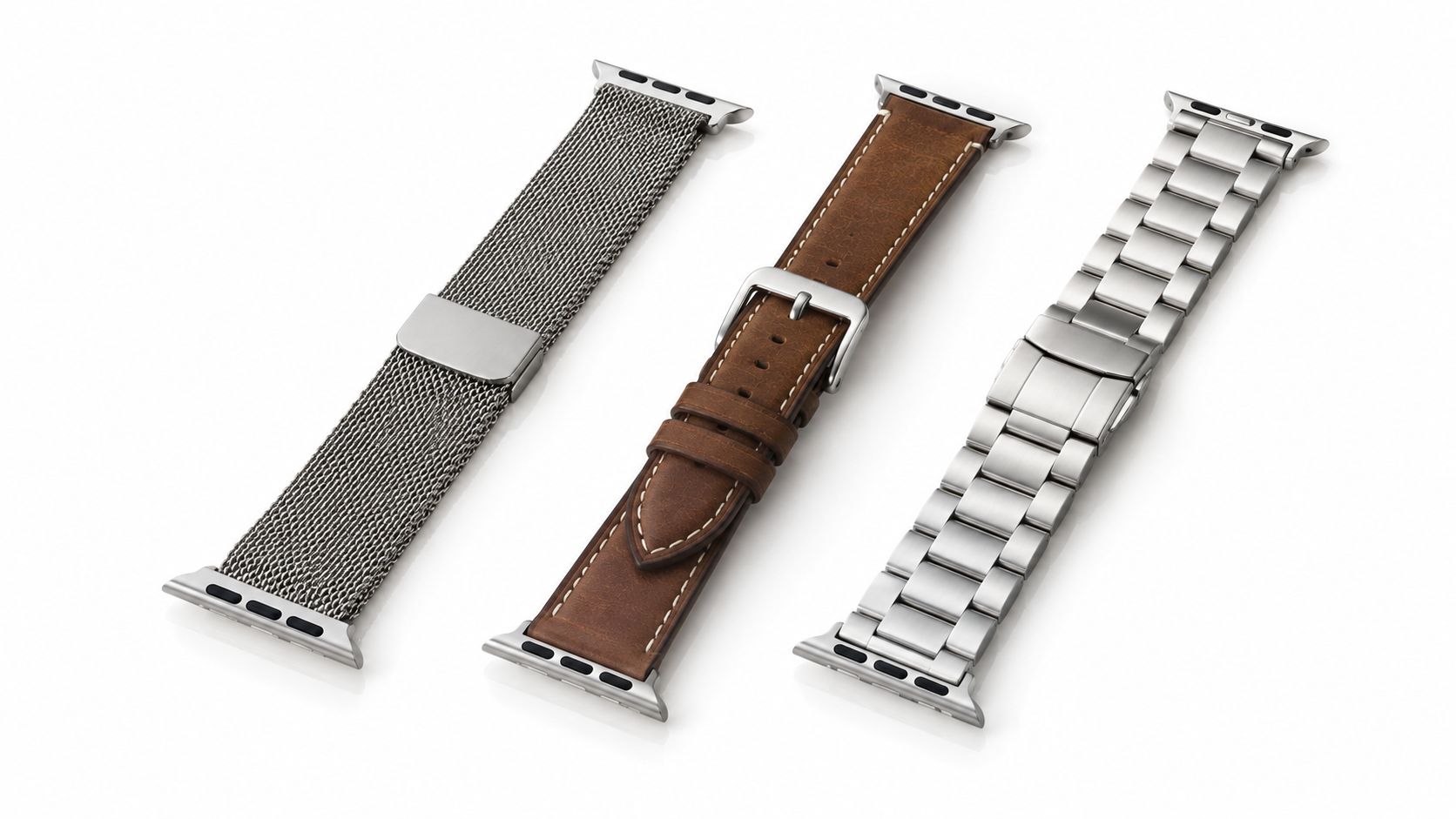
Milanese, leather, and link Apple Watch straps differ by construction, with Milanese Apple Watch straps woven from stainless mesh, leather Apple Watch straps cut as a flat strap with a tang buckle, and link Apple Watch straps built from individual connected pieces. All three read dressier than silicone or nylon, but they adjust, breathe, and age in completely different ways.
The photo below shows three structured replacement styles side by side, which makes the construction difference easier to see than to describe.
What Is a Milanese Apple Watch Strap Like to Live With?
A Milanese Apple Watch strap is a fine stainless steel mesh that adjusts continuously with a sliding magnetic clasp, so a Milanese Apple Watch strap has no holes at all. The mesh drapes like fabric but looks like metal, which is why the Lunor and Vayra work as the dress option that still fits between the sizes a buckle makes you choose. The tiny gaps in the weave let some air through, so mesh breathes better than a solid metal bracelet.
Care is simple, a wipe with a soft cloth, but mesh has quirks. The magnet can catch on laptop edges, and fine mesh can occasionally catch arm hair. On sustainability, Apple's own reporting covers the recycled content of its Milanese Loop in Apple's 2024 carbon neutral bands report. That report describes Apple's strap, and it's a reminder that recycled content is one signal, not a full lifecycle ranking.
What Is a Leather Apple Watch Strap Like to Live With?
A leather Apple Watch strap is a classic flat strap with a tang buckle and keepers, so a leather Apple Watch strap adjusts only at its punched holes. The Avelin, Harper, Leora, Perrin, and Noren genuine leather designs follow that traditional watch logic, pairing naturally with shirts and formal clothing. Leather starts firmer, softens with wear, and develops a patina that many owners value.
Leather asks the most care of the three. Keep a leather Apple Watch strap dry, let it rest between wears, and don't train in it, because sweat and water stain and stiffen leather over time. Breathability sits between silicone and nylon, comfortable at a desk, warm during exercise.
The short video below shows how structured straps sit and move on the wrist compared with flexible materials.
What Is a Resin Link Apple Watch Strap Like to Live With?
A resin link Apple Watch strap is built from individual resin composite links, so a resin link Apple Watch strap looks like a bracelet but weighs far less than steel. The Lyra Resin Composite Link for Apple Watch is the only resin composite link bracelet in this Apple range. Aaron Allen on the Lyra — Resin Composite Link — Apple Watch: "Really love this tortoiseshell link! It looks classy but isn’t heavy at all—super comfortable to wear all day. Definitely makes my Apple Watch feel more unique."
Links adjust by adding or removing pieces rather than by sliding, so the fit changes in steps. Braided, steel link, titanium, ceramic, and stretch Solo Loop style designs belong in this broader structured family as types you'll meet elsewhere, but they aren't sold here. Describing them completes the taxonomy without implying availability.
Which Apple Watch Strap Type Should You Choose?
You should choose an Apple Watch strap type by working through the three layers in order, Apple Watch case family first, closure second, material third. That order matters because each layer rules options out. The wrong case family won't connect, the wrong closure will annoy you daily, and only then does material decide whether the strap suits your routine.
How Do You Match an Apple Watch Material to Your Routine?
You match an Apple Watch material to your routine by naming what the Apple Watch strap must handle most often, not what it might handle once. Many individuals wear one strap for the majority of their week, so choose for the dominant pattern and rotate later if needed.
- Woven nylon Apple Watch straps: Light, breathable, and quick to re-tension, suited to daily wear, walking, and sleep.
- Silicone Apple Watch straps: Wipe-clean and quick-drying, suited to training, swimming, heat, and messy work.
- Milanese Apple Watch straps: Refined metal mesh with continuous magnetic adjustment, suited to office and evening wear, as shown across the Milanese mesh straps range.
- Leather Apple Watch straps: Classic tang-buckle formality, suited to dry, desk-based, and dressed-up days.
- Resin link Apple Watch straps: A bracelet look without steel weight, with the Lyra as the available resin composite example.
Which Apple Watch Strap Type Suits Sensitive Skin?
A woven nylon Apple Watch loop with no metal buckle against the skin can suit some people with a known metal sensitivity, while a silicone Apple Watch strap can suit people whose problem is mainly sweat. Start by distinguishing the cause. Irritation often comes from trapped moisture, soap residue, or a strap worn too tightly, not from an allergy.
That distinction has evidence behind it. Allergic contact dermatitis has been linked to metal watch-band clasps that contain nickel, and sweat can speed up metal corrosion and ion release at the skin. People who know they're nickel-sensitive are therefore steered away from Milanese mesh and stainless links toward textile loops, and everyone benefits from rinsing and drying a strap after sweating. Apple also notes that a strap worn too tightly may irritate skin, while one worn too loosely can rub, and poorly fitting third-party bands can interfere with wrist detection, so fit deserves as much attention as material.
Chooser in one line: Confirm the case, pick how you want to fasten it, then let your wettest, sweatiest, or dressiest regular day pick the material.
Nothing here produces a single winner, and that's the point of a taxonomy. An Apple Watch strap type is a combination, and once you can name all three parts of that combination, you can read any listing, spot what's missing from its description, and predict how the strap will behave before it reaches your wrist. Nothing but Bands sells replacement straps only, never watches, so every choice above assumes you're dressing a watch you already own.
If you've worked out your case family and know which closure you'd rather live with, browse the Apple Watch range at Nothing but Bands and filter by that family first, then compare silicone, woven nylon, Milanese mesh, leather, and the Lyra resin link on feel alone. You'll be choosing between straps that all fit your watch, which is the only comparison worth making.
Articles similaires

- October 26, 2026
Apple Watch band install made simple. Step-by-step instructions for sliding in a new band, closing every common clasp, verifying the...

- October 23, 2026
Learn how to adjust watch band size on metal link, Milanese, leather, silicone, and stretch straps with pro tips for...
