Need your wrist size fast? Here's the short version: wrap a tape measure (or a bit of string) snugly around your wrist just above the wrist bone, note the number, then add a bit of room depending on how snug you like your watch. That's really all there is to it — read on for the full step-by-step, three tool options, and how to dial in your ideal fit.
3 Key Takeaways: Measuring Your Wrist for a Watch
Measure where you wear it: Wrap a tape measure, paper strip or non-stretchy string just above the wrist bone and read the length.
Add room for your preferred fit: Add 0.5 to 1 cm for a snug sport fit, 1 to 1.5 cm for a standard fit, or up to 2 cm for a loose bracelet-style fit.
Measure in the evening: A later measurement can account for changes in wrist size during the day and help keep your band comfortable.
This is the quick version. For the full walkthrough with fitting advice by band material and watch case size, our complete wrist-fit guide covers that in depth.
How to Measure Wrist Size for a Watch in Four Steps
The core method takes less than a minute:
Position the tape just above the wrist bone (the ulnar styloid), exactly where your watch band will sit — not directly over the bone itself.
Snug it to the skin. The tape should touch your skin all the way round without pulling tight; a fingertip should slide underneath without pressure.
Read the overlap where the zero mark meets the tape, and note the number in centimetres or inches.
Add your fit allowance before ordering: 0.5–1 cm for a snug sport fit, 1–1.5 cm for everyday wear, up to 2 cm for a looser bracelet style.
This measures wrist circumference, unlike band width (the space between the case's lugs), which we cover separately below. While our watch band sizing explainer walks through both in detail, you can also use our Watch Band Finder tool for an easier, instant fit recommendation.
How We Tested These Wrist-Measuring Methods
We assessed the three methods below by checking whether each tool can sit at the intended position without stretching or compressing the wrist, whether its mark or reading can be transferred clearly, and whether the result can be repeated consistently. A measurement can be unreliable if the material stretches, slips, is pulled too tight, or is marked imprecisely. The flexible tape gives a direct reading; paper and string require careful marking and a ruler. These checks informed the practical guidance below, without treating any method as a substitute for a careful measurement.
A poorly-fitting watch band does more than just look a bit off; it can completely undermine the reason you bought the watch in the first place. If it's too loose, the watch will slide around your arm during a workout, leading to dodgy sensor readings and generally just being a nuisance. On the other hand, a band that's cinched too tight will dig into your skin, leaving marks and causing real discomfort throughout the day.
For smartwatch owners the stakes are higher still: heart-rate and blood-oxygen readings depend on consistent skin contact, so a loose band doesn't just annoy — it corrupts your data.
The most common measuring mistake in sizing questions is pulling the tape too tight for a "precise" number, which can leave the band too small. If you only fix one thing before measuring, fix the tension.
The fit also shapes how the watch looks. A correctly sized band keeps the case centred on your wrist, which matters most with these materials:
Beyond Function to Form
Metal Bands: These really need a precise fit. Too loose and they look sloppy; too tight and they'll pinch your skin.
Leather Straps: A good fit allows the leather to break in and mould to the shape of your wrist over time, without putting too much strain on the material.
Milanese Loops: While the magnetic closure on these offers micro-adjustments, starting with the correct size range is still the key to getting that sleek, gapless appearance. You can see how a Milanese Apple Watch band uses this design for a customisable fit.
Finding the Right Tools for the Job
You don't need any fancy equipment to get a useful wrist measurement. Chances are, you already have exactly what you need lying around the house, so you can get started in just a minute or two.
Using a Flexible Tape Measure
A flexible tailor's tape is the recommended choice. Because it's soft and pliable, it wraps around your wrist and gives you a direct reading. If you've got a sewing kit, you're all set.
No Tape Measure? No Worries.
Don't have one handy? A couple of everyday items can step in when you need to figure out your watch band size.
You can easily grab one of these instead:
A strip of paper: Cut a straight, thin strip from any piece of paper.
A piece of string: Use non-stretchy string or cord.
With either option, you'll also need a regular flat ruler to read the final length.
A Quick Word of Warning: The most important thing is to use something that doesn't stretch. An elastic band, for instance, will skew your measurement and can lead to a band that's too tight for comfort.
Three Foolproof Ways to Measure Your Wrist
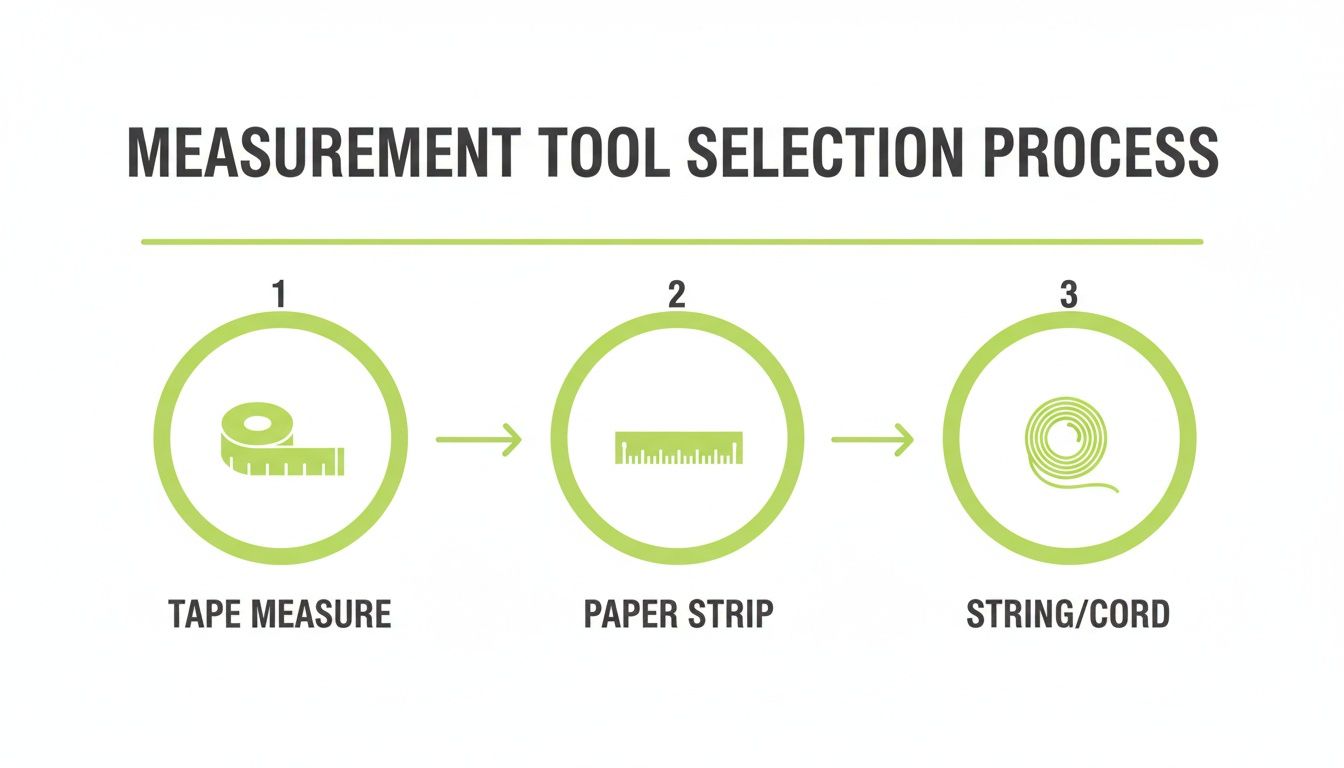
Right, let's get down to the practical part. Nailing your wrist measurement is simple, and you've got a few great options depending on what you have lying around the house. We'll walk through three reliable methods to find your perfect size, so you can pick out a watch band with complete confidence.
As you can see, you don't need any fancy equipment.
The Paper and Ruler Method
First, cut a straight strip of paper, about a centimetre wide.
Wrap it around your wrist in the same spot you would a tape measure.
Grab a pen and carefully mark where the paper overlaps to form a complete circle.
Finally, unwrap the paper, lay it flat against a ruler, and measure from the end of the strip to your mark. That's your wrist size.
The String and Ruler Method
Wrap the string around your wrist and hold the exact point where it meets. You can either pinch it firmly or mark it with a felt tip pen. Then, lay the string out straight beside a ruler to measure the length.
The only catch here is to make sure the string has no stretch or give to it. Stretchy string could give you an inaccurate measurement.
From Measurement to Perfect Fit
Finding Your Perfect Fit
Use this table to turn your raw circumference into a band length with the right fit allowance:
Wrist circumference
Snug sport fit (add 0.5–1 cm)
Standard fit (add 1–1.5 cm)
Relaxed fit (add up to 2 cm)
14.5–15.5 cm (~6 in)
15–16.5 cm
15.5–17 cm
~16.5–17.5 cm
15.5–17 cm (~6.5 in)
16–18 cm
16.5–18.5 cm
~17.5–19 cm
17–18 cm (~7 in)
17.5–19 cm
18–19.5 cm
~19–20 cm
18–19 cm (~7.5 in)
18.5–20 cm
19–20.5 cm
~20–21 cm
Exactly on a boundary? Size up — the extra range can help accommodate changes in wrist size and keeps buckle bands off their tightest hole.
Snug fits suit silicone sport bands and nylon loops because they keep the heart-rate sensor in contact; standard additions work for leather straps and flexible metal; looser additions suit bracelet-style bands.
Don't Forget the Watch Case
Your circumference also offers a starting point for choosing a case diameter that looks balanced:
Smaller wrists (under ~15.5 cm): Cases in the 36–40 mm range sit neatly; a 38 mm case reads as compact and classic here.
Average wrists (~15.5–17.5 cm): A 38 mm case looks understated, while a 42 mm case makes more of a statement — both can wear comfortably.
Larger wrists (over ~17.5 cm): 42–45 mm cases stay proportionate; a 38 mm case can look small.
Band width follows a separate logic: lug width must match the case exactly, with 20 mm described as a common modern width and 22 mm frequent on larger cases — though some smartwatches over 40 mm still use compact 20 mm attachments.
The case-to-wrist ratio is only one consideration; a comfortable band fit matters day to day. For metal link bands, fine-tuning often means removing a link or two — our guide on how to adjust a metal watch strap shows you how.
Common Sizing Mistakes to Avoid
Even with the right tools, it's surprisingly easy to get an inaccurate wrist measurement. A small slip-up can mean the difference between a band that fits comfortably and one that's either too tight or annoyingly loose. Here are a few common pitfalls to avoid.
The "Too Tight, Too Loose" Problem
One frequent mistake is pulling the measuring tape or string too tight. It's a natural instinct to cinch it for a "precise" reading, but this compresses your skin and gives you a measurement smaller than your true wrist size. You'll end up with a band that digs in.
On the other hand, leaving the tape too loose is just as bad. A floppy measurement can lead to a watch that constantly slides up and down your arm, which is irritating and can affect smartwatch sensor contact.
Finding the Right Spot and Tension
Another classic error is measuring directly over the bony bump on your wrist (the ulnar styloid). That spot is wider than where your watch band will sit, so measuring there can result in a band that's too big.
Here's how to nail it:
Find the sweet spot: Feel for the area just above your wrist bone, moving toward your elbow. This is the natural resting place for a watch. Measure there.
Check the tension: Keep the tape or string in contact with your skin without pressing into it. It should be secure but not constricting.
A quick tip from experience: Some materials, especially genuine leather, have a break-in period. They might feel a little stiff at first but will soften over time, moulding to your wrist.
For a comfortable fit, use the allowance that suits your preferred wear: 0.5–2 cm depending on the band style and how snug you want it. At Nothing But Bands, we try to take the guesswork out of it with clear sizing for every watch series and our 30-day money-back guarantee.
Your Sizing Questions, Answered
What If My Wrist Is Between Two Sizes?
Choose the larger option. Extra length gives you breathing room as your wrist size changes in heat or during workouts, keeps buckle bands off their last hole, and gives Milanese loops a wider magnetic range.
Does My Watch Model Affect the Band Size?
Yes — but in a different way than your wrist does. Your wrist measurement dictates the band length (Small/Medium vs Medium/Large); your watch model dictates the connector width that attaches to the case.
The perfect fit is a two-part equation: the right length for your wrist and the right connector width for your watch. Get one wrong, and the band simply won't work.
Your watch should stay in place without sliding excessively, but it shouldn't leave a deep mark when removed. The band should feel secure without pinching or restricting your wrist.
Measuring for someone else as a surprise gift? Direct measurement isn't always possible without giving the game away — our gift-sizing guide covers how to estimate discreetly and which band styles are the safest bet.
Frequently Asked Questions
How Do I Check My Wrist Size for My Watch?
Wrap a flexible tape snugly around your wrist just above the wrist bone, read the overlap, and add your fit allowance. No tape? Use the paper or string methods above, then measure the strip flat against a ruler.
What Size Watch Should I Get for a 7-Inch Wrist?
A 7-inch wrist is about 17.8 cm, near the upper end of the average-wrist range used in the case-size guidance above. Cases from 40 mm to 44 mm can look proportionate; a 38 mm case will appear more understated. Pair it with a band length around 19–20.5 cm including your fit allowance, and adjust to taste.
What Wrist Size Is a 38 or 42 Watch?
Using the case-size guidance above, a 38 mm case is a compact option for smaller wrists and looks understated around the average range of 15.5–17.5 cm; it can look small above that range. A 42 mm case makes more of a statement on average wrists and stays proportionate for larger wrists. These are styling guidelines, not hard rules — the band's fit matters more day to day.
Ready to find a band that fits your measurement exactly? Explore the full collection at Nothing But Bands
Written by Alex· Published January 4, 2026
· 11 min read
· Updated September 30, 2026
About the author
Alex — Founder, Nothing but Bands
Alex runs Nothing but Bands from Austin, TX. Every fit claim in these guides is verified against manufacturer specs — including the watches our bands don't fit. More about Alex →